Stamped Concrete Patterns: 10 Ideas for Your Sansom Park Patio
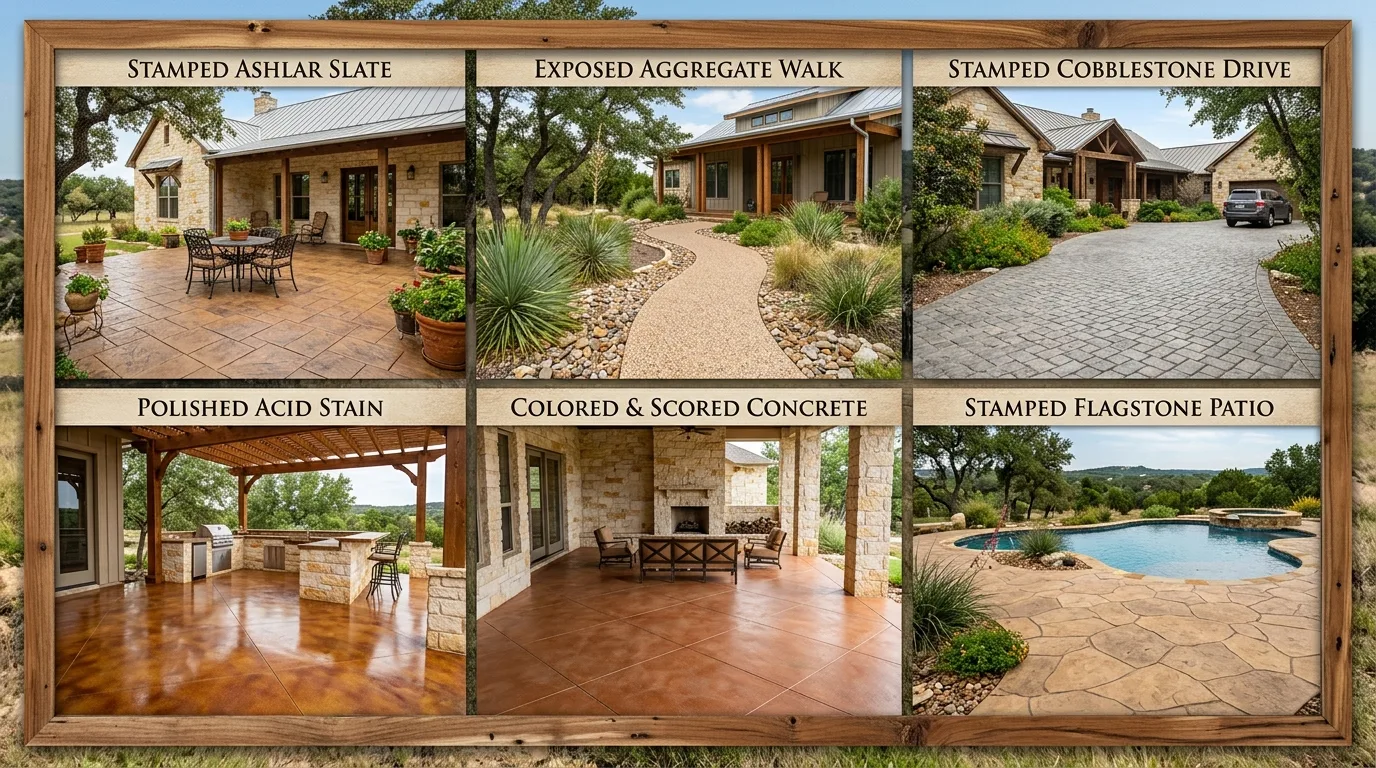
Stamped concrete has become one of the most requested outdoor surface options in the Sansom Park and Fort Worth area — and for good reason. It delivers the look of natural stone, slate, brick, or wood at a fraction of the material cost, with concrete’s durability built in underneath. But not all stamped patterns are the same, and choosing the right one for your outdoor space, architectural style, and maintenance tolerance matters. In this guide, we walk through 10 popular stamped concrete patterns used for Sansom Park patios and outdoor projects, with notes on appearance, use case, and maintenance requirements.
We’ll cover everything from the most popular flagstone and cobblestone patterns to newer wood-plank and seamless texture options, and close with guidance on choosing what’s right for your specific project.
Get a Stamped Concrete Quote for Your Sansom Park Patio
We'll help you choose the right pattern and color combination for your outdoor space. Free estimates.
Why Stamped Concrete Works Well in Sansom Park
Sansom Park’s outdoor lifestyle — near Marion Sansom Park and Lake Worth — makes the backyard a meaningful part of the property. Homeowners in the area invest in outdoor living spaces that look good, hold up to Texas weather, and require manageable maintenance. Stamped concrete checks all three boxes when properly installed.
The key in Sansom Park is proper base preparation. Houston Black Clay beneath patios requires the same 4–6” compacted gravel base, reinforcement, and control joints as any other concrete work — and on a stamped patio, a control joint crack is more visible and disruptive than on plain concrete. This is why proper installation is even more important for stamped work.
10 Stamped Concrete Pattern Ideas for Sansom Park
1. Irregular Flagstone The most popular pattern in the Fort Worth area. Irregular stone shapes mimic natural limestone or flagstone without the installation complexity or cost of real stone. Works with virtually every architectural style. Available in warm tones (tan, sandstone, terra cotta) that complement brick and stone homes common in North Texas neighborhoods. Great for large patios and pool deck surrounds.
2. Cobblestone Round-edged cobbles create an old-world aesthetic popular for formal patio dining areas and front entry walks. Tighter pattern with more visible grout lines (achieved with release agent color contrast). Works especially well in smaller accent areas or border treatments paired with larger-format patterns.
3. Ashlar Slate Large, rectangular interlocking pattern that gives a clean, contemporary look. One of the most popular patterns for modern and transitional home styles. The linear layout looks particularly good on square or rectangular patios with straight edges. Available in grays, blues, and charcoal tones that pair well with modern exterior finishes.
4. European Fan (Fan Pattern) A semicircular fan arrangement of smaller stones creates a formal, European appearance. Typically reserved for circular focal areas — outdoor dining circles, entry court accents — rather than full patio coverage. High visual impact, higher labor cost due to pattern complexity.
5. Wood Plank Linear planks that mimic real wood decking have surged in popularity as an alternative to actual wood. Avoid the rot, warping, and splinter maintenance of real wood while keeping the warm, linear aesthetic. Available in cedar, oak, or redwood color tones. Popular for covered patios and pergola areas where wood would be the natural choice.
6. Brick Running Bond Classic running bond brick pattern works equally well indoors and outdoors. Traditional and widely applicable. Available in red, brown, and gray tones. One of the most budget-friendly stamped options because the pattern is simpler and faster to apply. A good entry point for stamped concrete if budget is a consideration.
7. Herringbone Brick Brick pattern set at 45° angles creates a more formal, higher-end look than standard running bond. More labor-intensive. Often used as a border pattern around a plain or simpler interior pattern for visual interest without full-patio cost.
8. Seamless Slate Texture A single large-texture stamp applied in overlapping sections gives the appearance of flat slate without visible joint lines. Cleaner look than multi-stone patterns — works well for minimalist and contemporary outdoor designs. Easier to maintain because there are fewer recessed pattern lines to trap dirt.
9. Travertine Travertine-pattern stamps replicate the pitted, linear texture of natural travertine tile — popular in pool deck applications. Often done in lighter tones (cream, ivory, tan) that stay cooler underfoot in Texas sun than darker colors. Frequently requested for pool surround areas in the Lake Worth neighborhood where pool construction is active.
10. Random Stone Irregular, organic stone shapes without the regular size pattern of flagstone. More natural-looking than geometric patterns. Works especially well in landscape-integrated settings where the concrete transitions to plantings or natural stone features. Popular for garden path and side yard applications.
Choose Your Stamped Pattern — Sansom Park Concrete
We carry sample boards for all major patterns. Schedule a free consultation and estimate.
Practical Uses: Choosing the Right Pattern
- Large patios: Irregular flagstone or Ashlar slate — scale to the space well
- Pool surrounds: Travertine or seamless slate texture — lighter colors for foot-comfort
- Entry walks: Cobblestone or herringbone brick — formal appearance appropriate for front entry
- Covered patios: Wood plank — complements pergola and ceiling material
- Contemporary homes: Ashlar slate or seamless texture — clean lines
- Traditional homes: Flagstone, brick running bond, or cobblestone — classic materials language
Color Considerations for North Texas
Color hardener is broadcast onto the freshly placed concrete and determines the base tone of the finished surface. Release agent is dusted on the stamp to create contrast in the pattern lines. Common color combinations for Sansom Park area homes:
- Sandstone + terra cotta release: Warm, natural appearance that pairs with brick homes
- Charcoal + gray release: Contemporary, works well with light-colored homes
- Flagstone tan + brown release: Mimics limestone, appropriate for North Texas landscape
- Weathered wood tones (for plank pattern): Browns and grays that read as natural wood
UV fading is a real consideration in the 228-day-sunshine Sansom Park area. Darker integral colors (deep charcoal, dark red) tend to fade faster than medium tones without regular resealing. Plan for UV-protective sealer applied every 2–3 years.
Process: How Stamped Concrete Is Installed
The stamping window is the most time-critical phase of concrete installation — it requires the concrete to be at exactly the right plasticity to accept the pattern clearly. Too early, the stamp sinks too deep. Too late, the pattern doesn’t register clearly. Weather conditions (particularly temperature and humidity) affect how quickly the concrete reaches the stamping window. In Sansom Park’s summer heat, this may be a narrow window that requires multiple crew members working simultaneously. In fall and spring ideal conditions, the window is more forgiving.
After stamping, the surface cures for 24–48 hours before sealer is applied. Sealer enhances color, protects the surface, and adds the sheen that makes stamped concrete look its best.
Cost Factors
Stamped concrete in the Sansom Park area runs $14.25–$15.00/SF installed for standard single-pattern work. Multi-color or complex border patterns add $1–$3/SF. Resealing every 2–3 years runs $0.30–$0.50/SF DIY or $0.50–$0.75/SF professionally applied.
See our concrete cost guide for Sansom Park for complete pricing comparison across all finish types.
Frequently Asked Questions
How does stamped concrete hold up to hail in Sansom Park?
Concrete is highly durable against hail impact — a standard 3,500 PSI slab at 4” thickness will not be damaged by hail. The sealer on the surface may show micro-pitting from severe hail (baseball-sized), but this is a cosmetic issue addressed with a fresh sealer coat. The pattern and structural integrity of the concrete are not affected.
Can stamped concrete be added around an existing plain concrete patio?
Yes — if the existing patio is structurally sound and the height differential can be managed, a stamped concrete addition or border can be integrated around an existing plain slab. The challenge is matching the elevation and ensuring the new pour bonds correctly to the existing edge. This is a common approach when homeowners want to expand and upgrade an existing patio.
Does stamped concrete stay cooler than pavers in Texas summer sun?
Color has more impact than surface texture on heat absorption. Light-colored stamped concrete (cream, tan, ivory tones) stays meaningfully cooler underfoot than dark-colored concrete or dark pavers. Traditional brick-red stamped patterns retain more heat than travertine-tone or gray options. For barefoot-comfort applications, specify lighter color palettes.
Related reading: concrete patio vs. stamped concrete comparison | stamped concrete service page | concrete cost in Sansom Park
Design Your Stamped Concrete Project in Sansom Park
Free consultations with sample boards. Sansom Park Concrete serves Tarrant County including Lake Worth, River Oaks, and Fort Worth.